

How To Catch Blue Swimmer Crabs
Posted by Tackle World Adelaide Metro on 24th Sep 2020
Catching Blue Swimmer Crabs is one of the most fun and rewarding fishing activities you can take part in.
What makes catching Blue Swimmer Crabs so appealing? Well for starters, it is one of the cheapest ways to catch your own seafood. Crabbing gear is very inexpensive. Quality Crab Nets these days will only set you back $10.00 each, and Rakes about $14.00 each. The value is exceptionally good compared to other fishing tackle.
Blue Swimmer Crabs are also very tasty! Another benefit is their versatility on the plate. They are commonly enjoyed straight out of the pot, in salads, tacos and soups.
Furthermore, Blue Swimmer Crabs are not too difficult to catch, provided you know how to catch them. If you are not sure, we are here to help! After reading this article, you will have the knowledge required to be catching Blue Swimmer Crabs in no-time.
Species Information
Blue Swimmers Crabs are the largest recreationally targeted Crab in South Australia. Total length from claw-to-claw can exceed 80cm with any crab claw-to-claw length over 70cm considered big.
Although claw-to-claw length is the adopted measurement for bragging rights, it is the carapace length that needs to be measured for minimum legal size. 11cm measured across the carapace from the base of the largest spines to be exact.

The daily personal bag limit for Blue Swimmer Crabs in South Australia is 20 per person (combined with Sand Crabs). The daily maximum boat limit for Blue Swimmer Crabs in South Australia is 60 per boat with 3 or more people on board (combined with Sand Crabs).
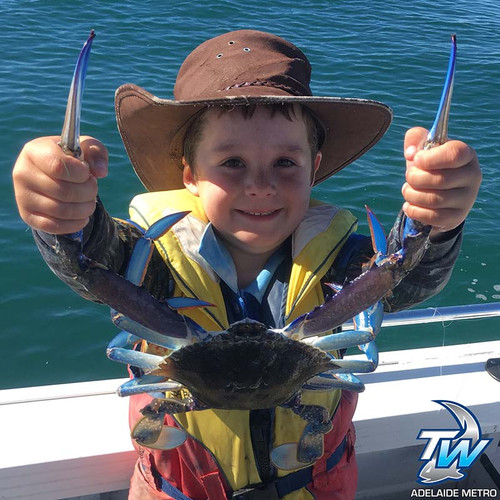
Female Blue Swimmer Crabs are mostly brown in colour, have red tipped claws, and carry their eggs externally under their abdomen flap (which is distinctively different to males). All Blue Swimmer Crabs with eggs are fully protected and must be returned to the water immediately.

Gear
There are 2 common methods to catching Blue Swimmer Crabs. You can either catch them by net from land or boat, or they can be caught by raking from the beach.
Netting Blue Swimmer Crabs is more popular so we will begin with the required equipment for this style of crabbing first.
You will need:
- Crab Net(s)
- Bait Clips
- Measuring Device
- Bait Pouch (optional but recommended)
- Rope (for jetty or deep water)
- Float (Boat only)

The Crab Net is the core piece of equipment for this style of crabbing. It is essentially the trap that catches them. You are allowed up to 3 double-hooped nets per person.
Bait Clips are used to either secure bait to the Crab Net or secure a Bait Pouch to the Crab Net.
The Measuring Device is used to determine whether the Crabs you catch are of legal size or not. This tool is more reliable than a ruler or measuring tape.
Although not essential, we recommend purchasing a Bait Pouch for each Crab Net. Pouches protect your bait from being eaten too quickly by Crabs and other sea life. This will preserve your bait for longer meaning less bait is needed for a session.
Spare Rope increases the depth, distance, and area you can cover with your Crab Net. Remember Crabs live on the ocean floor. Keeping your Net on the bottom is critical to success.
Floats are needed for leaving Crab Nets unattended on the water (boat or kayak). They need to be labeled with your name and address.
Moving on to raking, the required equipment includes:
- Crab Rake
- Measuring Device
- Crab Trolley or Bucket
- Appropriate Footwear
- Polarised Sunglasses (optional but recommended)
The Crab Rake is used to scoop Crabs that are either in the sand, weed, or are free swimming.
The Measuring Device is used to determine whether the Crabs you catch are of legal size or not. This tool is more reliable than a ruler or measuring tape.
Crab Trolleys are advantageous as they are made to roll on land like a cart, but also float when in the water. They are attached to you via rope, so it follows you and does not drift off with the wind or tide. They can be expensive to buy and time consuming to make in comparison to a standard 20L Bucket. A Bucket can suffice if the budget does not stretch; although, investing in a Crab Trolley is more beneficial in the long run.
Footwear is critical in areas that Crabs are found as there can be some nasty surprises under the sand and weed, plus you may need to walk over reef. Razorfish and Crabs are likely to give you a cut or a nip on the foot which may cause injury, and potentially end your session. Reef shoes, old sneakers or aquatic shoes are adequate for most applications.
Polarised Sunglasses cut through the glare of the sun and identify contrasting colours on the bottom with ease. They aid in finding Crabs, which we will explain later in this article.

Bait
Bait is required for crabbing with a net.
Bait attracts Crabs to the net and keeps them inside the net before the net is pulled in.
In South Australia, blood, bone, meat, offal, and skin of any animal other than fish, worm, or insect cannot be used as bait within 2 nautical miles from shore. Therefore, fish is used as bait exclusively land based or within 2 nautical miles from shore.
Our favoured baits for Blue Swimmer Crabs are:
- Flathead Heads
- Whiting Heads
- Carp
- Salted or Brined Pilchards.
Although these baits can be bought from our store, you can use any fish carcass you may have caught previously. This excludes seafood sold for human consumption as it has the potential to spread aquatic disease.
Attaching bait to the Crab Net can be achieved with a Bait Clip and a Bait Pouch as mentioned earlier.
No bait is required for raking.
Technique
Setting your net is quite simple. Follow the steps below:
- Tie the Crab Net off to something sturdy and secure like the jetty (or a float if leaving unattended on the water) with the tag end of the rope to ensure you do not lose your Crab Net.
- Secure the bait or Bait Pouch (with bait) to the base of the Crab Net using Bait Clips.
- Clear the area of items or people that the Rope can potentially catch as the Crab Net is thrown.
- Throw the Crab Net into the water with the base facing down and the larger outer ring and bait facing up. It is like throwing a big frisbee.
- Watch the Crab Net as it sinks to make sure it is sinking base first and not upside-down. If it is sinking upside-down it will need to be pulled in and re-thrown.
- Wait 15-20 minutes before checking the Crab Net for Crabs.
- When the Crab Net is ready to be checked, pull in as much slack line as possible until the weight of the Crab Net can be felt. As soon as weight is felt, pull the Crab Net in as fast as possible to avoid any Crabs escaping the Crab Net as it is retrieved.
- Bring the Crab Net onto the jetty, boat, or land. Remove Crabs from the Crab Net, measure them, check for eggs, check your bait and repeat the process from step 3 until it is time to leave.
Raking:
- Dress with the correct Footwear and Clothing. Ensure the Rake, Measuring Tool, and Trolley/Bucket is ready.
- Start looking for Crabs in the sand. Look for a slight mount that is different in colour as a Crab may be buried underneath the mound. They can also be found in weed or free swimming.
- Once found, place the Rake over the mount or in front of their claws. The Crab should latch onto the rake with its claws. Flip the Rake and the Crab upside-down as they are brought out of the water.
- Place them into the Bucket/Trolley.
- Repeat from Step 2 until it is time to leave.

Locations
Blue Swimmer Crabs are more widespread than the general population is aware of. They are commonly caught on the Adelaide Coast and most towns on the Yorke Peninsula. Some huge Blue Swimmer Crabs are caught at Port Augusta, Whyalla, Port Lincoln, and even Kingscote on Kangaroo Island!
Majority of Blue Swimmer Crab spots are within St Vincent Gulf and the eastern side of Spencer Gulf. With that in consideration, we will concentrate on this general area.
There are plenty of locations within a few hours’ drive from Adelaide where you can catch Blue Swimmer Crabs as highlighted on the map.

1.Brighton Jetty
2.Grange Jetty
3.Tennyson Beach
4.Semaphore Jetty
5.Thompson’s Beach
6.Tiddy Widdy Beach
7.Ardrossan Jetty
8.Stansbury Jetty
9.Moonta Bay Jetty
10.Wallaroo Jetty
All legal
information including size limits, bag limits, permitted equipment and other
rules of this nature were obtained by PIRSA - 2020 - https://pir.sa.gov.au/fishing/fishing_limits/blue...
