

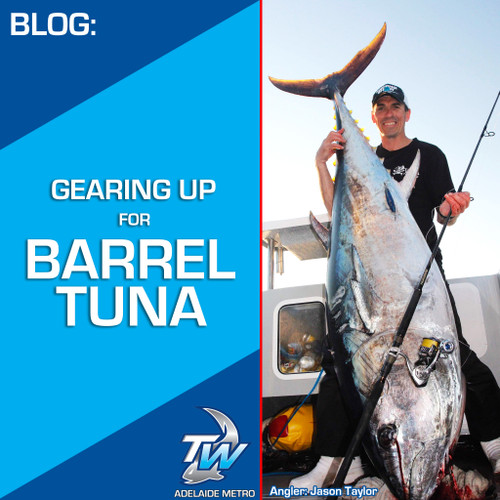
Gearing up for Barrel Southern Bluefin Tuna
Posted by Tackle World Adelaide Metro on 20th Apr 2021
Catching a 100kg+ Southern Bluefin Tuna in Australia’s South-East in one of Australia’s great game fishing accomplishments. There is no room for cutting corners in this extreme style of fishing!
Introduction:
Southern Bluefin Tuna over or about 100kg are considered ‘barrels’ in southern Australia. Throughout the cooler seasons, these huge fish migrate along the southern coast of Australia and are caught at renown spots like Port MacDonnell in South Australia, Portland and Port Fairy in Victoria, and Eaglehawk Neck in Tasmania. These big Tuna are found in large seas open to the Southern Ocean, sometimes up to 100km from shore, but more commonly between 20km – 60km. At times, they are even as close as 1km in certain locations like Eaglehawk Neck.
Game fishing opportunities are more limited in South-East Australia compared to the tropics. Thankfully, the southerners are fortunate to have these monster Southern Bluefin Tuna in their area for part of the year. Although they may not jump like a Marlin, the speed a barrel can shred line from your reel is as quick as it gets. If you are an avid game angler, no matter where you are in Australia, or even the world you must get down south to experience the power and sheer size of these incredible SBT’s!
Gear overview:
As mentioned in the foreword, there are no cutting corners when choosing your tackle. Some of best gear money can buy is required to handle these true monsters from hook-up to landing. If you have ever wondered why some fishing rods and reels can be more than $1,000, this is the type of fishing they are designed for.
Unfortunately, many anglers who have used sub-par rods, reels, line, and terminal tackle experienced the heartbreak of losing the fish of a lifetime. Barrel Tuna are the type of fish that will find and exploit any weakness in your tackle and have proven to do so time and time again. If you are beginning your barrel fishing journey, approach it with the mindset of a perfectionist. Everything you purchase for this fishing feat should be of the best quality you can afford.
Trolling
Trolling is the most popular and effective way to catch a barrel. Typically, a spread of medium-to-large sized trolling skirted lures are towed behind the back of the boat around the edge of baitfish schools or in areas of recently known activity. The required tackle is exclusively used for trolling.
Rod & Reel
The rod and reel combo required is an overhead game reel with a minimum line capacity of 600m of 24kg monofilament or heavier paired with an overhead roller game rod to suit the class of mainline. (Example: 24kg monofilament mainline requires a 24kg game rod)
Ideally, stick with these two weight classes: 24kg & 37kg. A 24kg combo is suitable for 90% of trolling lures. If you are not sure where to start, choose a 24kg combo. A 37kg combo has its advantages as well. If you are strong, or would like to reduce the fight time, or troll bigger lures and spreader bars, then a 37kg combo is worth considering.
Ideal combos:
24kg: Shimano Tiagra 50WLRSA + Shimano Tiagra T-Curve 24kg Stand-Up Straight Butt
37kg: Penn International VISW 80 + Shimano Tiagra Ultra 50-80 Dual Butt
Line & Wind-on Leader
Traditionally, monofilament was used exclusively as a mainline for game fishing. These days, braid is becoming more popular due to the diameter to strength ratio. Braid allows anglers to achieve more line capacity without compromising on strength. Game reels with braid are generally spooled halfway or two-thirds full and the remaining space is filled with monofilament. This is known as a ‘top-shot’. Due to braid’s thin diameter, an angler may choose to decrease their reel size to reduce the weight of their set-up.
The disadvantage of braid is it can be difficult to guide back onto the reel mid-fight without cutting your hands to bits. Plus, it is expensive compared to monofilament and can break easily if meet with sharp debris like barnacle encrusted crayfish pot bouys. The choice is up to you, however, if you are new to barrel trolling, we recommend starting with monofilament straight through because it is more forgiving and easier to manage.
Regardless of the type of mainline you choose, a wind-on leader is highly recommended. A wind-on leader is attached to the end of your mainline by connecting a bimini twist to the pre-tied loop on a wind-on leader. The wind-on leader is often 2-6 times heavier than your mainline and primarily does two things; 1) it protects your mainline from the fish (the tails and gills rakers can rub through thinner line) 2) gives the deckhand a stronger, thicker line to control your fish boat side.
Ideal lines:
Braid – YGK Galis Jig Man X8 600m PE 8
Mono – Buku IGFA Tournament Line 24kg or 37kg
Wind-on Leader – Instinct Pro Series Wind-on Leader 200lb, 300lb, or 400lb
Skirts
Skirted trolling lures are the preferred lure choice for barrel Tuna. The shape of the head determines the action of the skirt and will dictate where it should be positioned in your spread.
Barrel skirts sit in the size range of 9” – 13”. Skirts on the smaller end of the spectrum work well on barrels as they often match the profile of the bait they are feeding on; Redbait and Pilchards. The problem with smaller skirts is they tend to catch a lot of school tuna as well (fish up to 30kg). The more time you spend reeling in school tuna, the less time your lures are in the water for a barrel. School Tuna rarely hit skirts over 12”, but barrels do. Big skirts also match the bait profile of Slimy Mackerel, Arrow Squid, and big Redbait. Big skirts are not out of place in barrel country.
For the most part, colour is a personal choice, although in recent times pink & blue skirts have outperformed most other colours. Other proven colours include lumo green, blue and silver, and black and yellow. Winged skirts add extra flash.
Top 3 Skirts:
Alternative Lures
The most used alternative lure type for barrel Tuna are hard body divers. They are a point of difference in a spread of skirts as they dive, swim, vibrate, and flash. Hard bodies are best run in a short corner position under the prop wash.
Most barrel hard bodies are more than 180mm long and dive from 10ft - 40ft. 180mm+ size is perfect as it replicates baitfish profiles well without being small enough for most school Tuna. Colour is a personal preference, however natural colours are favoured. Stick with patterns that imitate Slimy Mackerel, Pilchard, Redbait, and Squid.
Example lure: Samaki Pacemaker 180D

(The above image includes some of the best lures and their best spot in the spread)
Rigging
Rigging your lures is one the most crucial aspects of barrel fishing. Poor rigging will almost always end in gear failure. Good rigging often leads to success.
Rigging lures requires the following items:
- Leader line
- Game fishing hooks (skirts only)
- Aluminum single sleeve crimps
- Suitable crimping pliers
- Loop protectors / rigging tube
- A cigarette lighter
- Stainless steel ball bearing snap swivel
The strength of the leader line is determined by the skirt you are trolling. Most manufactures will provide a recommend line class for a particular skirt. It is best to stay within their recommendations. For alternative lures like hard body divers, leaders between 250lb – 350lb are suitable.
Game fishing hooks need to be sharp and strong enough to withstand immense pressure for an hour or more without breaking. Hooks sizes are not equivalent between brands, but to give you an idea of physical hook size we recommend Owner Jobu Big Game hooks in sizes 8/0 – 12/0 for most skirts.
Aluminum single sleeve crimps are essential. Copper sleeves are intended for wire only. Copper sleeves also have a sharp edge that can cut monofilament. The crimp’s diameter needs to closely match the line’s thickness. Example: if the line diameter is 2.00mm, the required crimp will be approximately 2.00mm – 2.5mm.
Crimping pliers or crimping tools are needed to complete the crimping process. You will need to ensure the crimping tool you have or are purchasing will cover the diameter range you require. When crimping, ensure you crimp the middle of the sleeve and test the crimp before you go fishing.
Loop protectors and rigging tube are designed to avoid bare monofilament line rubbing out on the eye of the hook or loop to swivel during the fight. It is an insurance policy against gear failure.
A cigarette lighter is used to bud the end of cut line. Although this activity may seem unnecessary, the thickened tag end of your line is an insurance policy to avoid line slippage if a crimp fails to hold.
The stainless-steel ball bearing swivel connects your wind-on leader to your lure rigged line. Stainless steel is used for best corrosion resistance. Ball bearing swivels swivel more freely than crane swivels and are less likely to seize.
We recommend the following products for rigging:
- Instinct XTS Tough Leader
- Owner Jobu Big Game Hooks
- Optia Aluminum Single Sleeve Crimps
- Optia Mini Hand Crimper
- Optia Loop Protector
- Optia Stainless Steel Ball Bearing Snap Swivel
Teasers
A teaser is an attractant trolled behind the boat with the objective of drawing fish to your lures from a wider area. They can take the form of a daisy chain, flasher, exciter bird, or spreader bar. Although not the most essential piece of tackle to take with you, it can enhance your results.
A way to justify the purchase of a teaser is to think of a real-life scenario like this: You have travelled by car and sea to find these fish; you have invested in some of the best gear for the job. After trolling all day (without a teaser) you arrive back at the ramp unsuccessful. As it turns out, you were so close to hooking-up. You trolled 100m away from a school of hungry 100kg Bluefin. If you had a teaser, you would have caught their attention and they would have come in for a closer look. Then they spot your spread of lures swimming away frantically. One of the barrels decides to eat your skirt, and you would’ve hooked-up! All because a flashing piece of metal or a bunch or rubber squids caught the attention of a nearby school.
The above scenario is how a hook-up happens sometimes. So, is it worth leaving the teaser behind? To increase your chances, it is worth bringing.
Casting
The method of casting lures at barrels is growing in popularity. Casting for barrels requires the crew to find visual schools of fish feeding on the surface, then lures are casted at them and retrieved to entice a hook-up. The appeal of casting for barrels are the hectic surface strikes, catching 100kg fish on spin tackle, and feeling their entire powerful first run.
Rod & Reel:
Rod and reel combos for casting at barrel Tuna are again specific. Although it is theoretically possible to troll with them, it is not recommended due to the length of the rod. Running 12kg of drag for an hour or more through an 8ft pole is something you should avoid if possible. Your body will thank you later.
The rod needed for this application is 7’9” – 8’3”, PE 8-10, cast weight 60-200g. Although these specs are pre-requests, you will need a rod that is not too stiff. GT Popping rods are too stiff. GT popper rods are made to work big cup faced lures and rip fish away from structure as fast as possible. Barrel Tuna fishing is not a game of speed and strength, it is a game of endurance. For this reason, you will need a rod with an action that is soft enough to avoid pulling hooks, and still has the power to run up to 12kg of drag to somewhat control these big fish.
The reel without a doubt needs to be one of the best 18000 or 20000 high-speed saltwater spinning reels money can buy. Put simply, the top of the range spinning reels such as the Shimano Stella SWC and Daiwa 20 Saltiga are made from solid metal bodies and gears, super rigid rotors and bails, smooth line rollers and bearings, and carbon drag systems designed to avoid overheating. These are all essential features for fighting barrel Tuna for over an hour on spin tackle. Most other spinning reels are not up to the task. Out of all the gear require for casting at barrels, this is the one piece of equipment you 100% should not cut corners on.
Ideal casting combo:
Daiwa 20 Saltiga 20000-H + NS BOCA S S-80 Popping Rod (although popping is in the rod’s title, the blank has the perfect taper: not too stiff in the tip, plenty of power down low)
Line & Leader
Braid is the only choice for mainline due to its long casting abilities and strength. Stick with PE 8 and PE 10 braided lines. PE 10 is desirable as the thicker line has a better chance of holding up against debris and the fish’s fins. The suggested spinning reel sizes have approximate spool capacities of 300m of PE 10 and 400m of PE 8. The extra line capacity is the advantage of PE 8. To avoid getting spooled, the skipper plays a crucial role in keeping line on the reel. Braid colour is a personal choice, although colours that blend in with the environment like blue or white may give you an advantage on tough days.
An 8 carrier (8 strand) braid or higher will give you better casting capabilities compared to 4 carrier braids. However, 4 carrier lines offer better abrasion resistance over 8-carrier lines. Consider your preferences before spooling your reel as neither line is better than the other due to the advantages and disadvantages.
Because you are unable to run a 15ft or longer wind-on leader when casting, the type of leader you choose is quite important. An ideal line will have great stretch to prevent pulled hooks, as well as low light refraction to avoid spooking wary fish. Line class should be above 130lb with 170lb – 200lb ideal. The length of your leader should match the length of your rod. A rod length of leader is the happy medium between maximum stretch and maximum casting distance.
Best Products:
Braid: YGK Ultra Castman 2 WX8 300M – PE 8 – 113lb
Leader: Varivas Avani Maguro Shock Leader – 170lb
Lures
The best casting lures for barrels are floating and sinking stick baits. The high-quality custom stick baits work best for the following reasons:
- 1. They are built tough using thick through-wire construction and high impact resin or wooden bodies
- 2. The pattern and finish are as realistic as it gets
- 3. Their action mimics a real dying or panicked baitfish
For barrel Tuna, you need a lure that can stand up to their jaw power for the entire fight duration, and you need a lure that looks and swims real enough to get a bite. With this in mind, we recommend spending the extra cash on lures that will not let you down and have the highest chance of getting a hook-up.
Floating stick baits work best in calm conditions with minimal bird activity. Unfortunately, birds dive on floating stick baits; plus, floating stick baits tend to flail out of the water in choppy seas. Although floating stick baits have these disadvantages, they draw the best surface hits, and they are an easy target for a barrel.
Sinking stick baits on the other hand are better in rougher conditions or when birds are present. Floating stick baits tend to flail out of the water in choppy seas. A sinking stick bait will sink below the choppy surface and the birds, allowing the angler to present the lure with a natural swimming action consistently.
Single hooks are best for barrels as they hold better than treble hooks, however, some lures have a better action with treble hooks. You should base your hook configuration decisions on the manufacture’s recommendations.
Split rings need to be as strong as possible to decrease the chances of gear failure. If you are using a smaller stick bait or a floating lure, a smaller sized split ring may be required to keep the lure’s action intact. An extra-heavy split ring and stainless-steel ball bearing swivel should be the connection between lure and leader. This combination facilitates the ability to tie a strong, reliable knot like a uni or AG chain as opposed to a loop knot that can rub and break during long fights; and it makes changing lures easy with a pair of split ring pliers, avoiding the need to re-tie leader and lure knots as often.
Use the ‘match the hatch’ approach when choosing lure size and colour. A spread of lures that imitate Slimy Mackerel, Redbait, Pilchards, and Squid will cover all bases. These are the best casting lures we recommend for barrel Tuna:
- Strategic Angler Proteus 130 – Redbait
- Strategic Angler Walker – Blue Mackerel
- Strategic Angler Cruiser – Mediterranean Sardine
- Strategic Angler Espada S – Mediterranean Sardine
- Strategic Angler Naia 180 – Market Squid
- Strategic Angler Mikros S – Blue Mackerel
Other important gear
An equalizer harness gives you a fighting advantage and it can prevent injury. An equalizer harness distributes the load evenly across your legs, back and pelvis, this allows you to fight for longer and apply more pressure on the fish, reducing fight time. It also gives your back much needed support. We highly recommend investing in an equalizer set for heavy game fishing.
High-quality gaffs are also required to bring fish aboard, or to control the fish boat-side for catch and release.
Outriggers are beneficial for trolling as they widen your spread, covering more ground and reducing tangles.
Conclusion
Gearing up for one of the Southern Ocean’s best game fish is a task that should not be taken lightly. These monster Tuna are notoriously known for testing the best tackle and the best anglers. Our guide was designed to help newcomers gear up properly the first time, and to give tips and pointers to those who are struggling to bend a rod. The team at Tackle World Adelaide wishes you all the best in your giant Southern Bluefin Tuna pursuits!
Thumbnail Image Credit: Jason Taylor
Instagram: @acejasee
